
Storm & Insurance
Tampa Roofing 2026: A Complete Storm Season Outlook
Tampa Bay homeowners: here's what the 2026 storm season looks like, plus how to prep your roof, your policy, and your post-storm response. From the Roof Gurus.
By Rene Diaz Jr, President · FL Certified Roofing Contractor CCC1330839
Published April 22, 2026 · 10 min read
Florida is heading into another active storm season. The forecasts are out. The water in the Gulf is already warm. And if you live in Tampa Bay, your roof is the single biggest variable between a noisy weekend and a four-figure repair bill.
We've spent the last decade replacing, repairing, and tarping Tampa roofs after every named storm from Irma to Milton. The pattern doesn't change much. The houses that come through clean are the ones whose owners did three or four small things in May. The houses that don't are usually fixable, but only if the homeowner moves fast and documents well.
Here's the honest 2026 outlook, plus the prep checklist we give every customer who asks.
What forecasters are saying about 2026
The major seasonal outlooks from NOAA's National Hurricane Center and Colorado State University both project an above-average Atlantic season. The drivers are familiar: warmer-than-average sea-surface temperatures across the main development region, neutral-to-La-Niña conditions over the Pacific, and reduced wind shear over the Caribbean.
For Tampa Bay specifically, that doesn't mean a guaranteed direct hit. It means the probability of a brushing storm, a tropical-storm-force wind event, or a hurricane within 150 miles is elevated. In our experience, those near-misses do almost as much roof damage as direct hits, because homeowners assume "it didn't really hit us" and skip the post-storm inspection.
A few numbers worth remembering:
- The official Atlantic season runs June 1 through November 30.
- Tampa Bay's peak risk window is mid-August through mid-October.
- The average storm damage claim in Hillsborough County after a major event runs $8,000 to $30,000, with the bulk of that being roof and water-intrusion repair.
What Tampa storms actually do to your roof
After every named storm we get the same surprised phone calls. "I thought the roof was fine." It usually isn't.
Here's what we see most:
- Lifted shingles. Wind doesn't have to tear shingles off to ruin them. A 70 mph gust can break the seal strip underneath, leaving the shingle flapping invisibly until the next rain pushes water under it.
- Cracked tiles. Flying debris (palm fronds, branches, neighbor's pool umbrella) cracks tiles without dislodging them. From the ground it looks fine.
- Underlayment punctures. Most tile leaks aren't tile failures, they're underlayment failures. Our tile roofing page explains why.
- Ridge-cap failure. The ridge of your roof is the highest-load point in any storm. We replace more ridge caps than any other single component in October and November.
- Flashing separation. Around chimneys, skylights, and stack vents, sealants get tired. Wind-driven rain finds those gaps every time.
- Soffit and fascia damage. Wind getting under the eaves can lift entire soffit runs and let water into your attic.
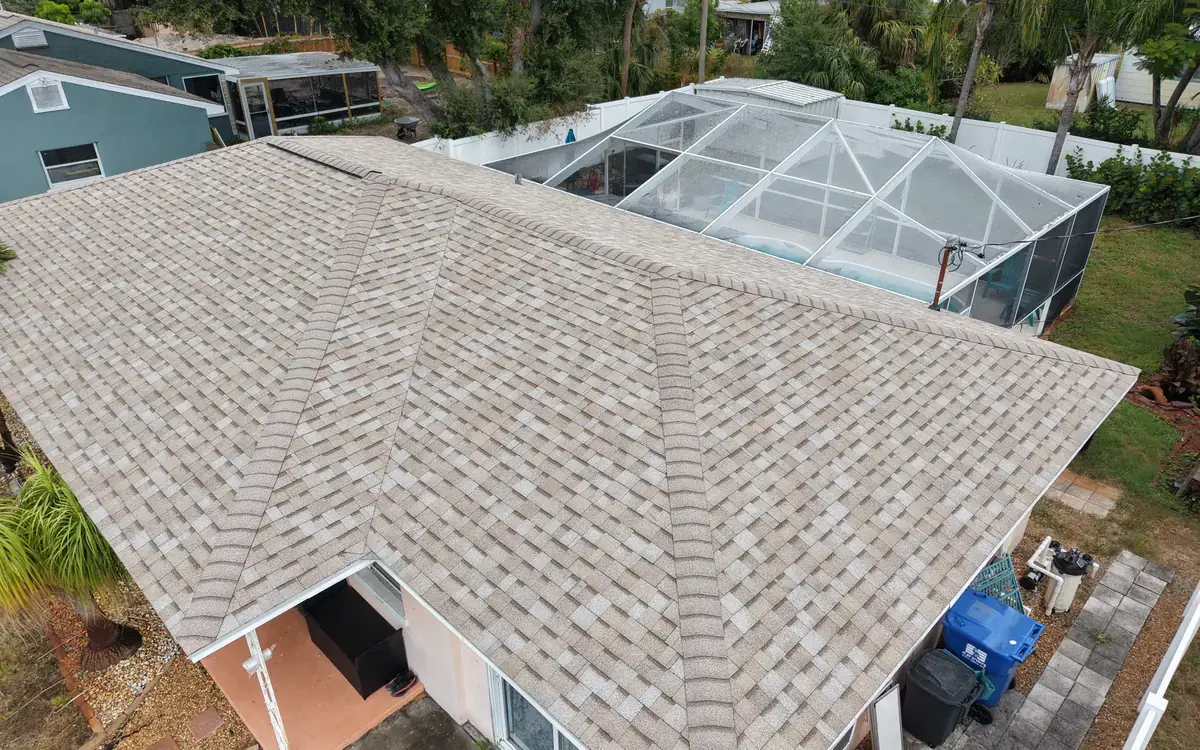
The frustrating part is that most of this damage is invisible from your driveway. You need someone on a ladder to find it. That's what our free inspection is for.
The pre-season roof check (do this in May)
If you do nothing else this month, do this list. Most of it takes a homeowner 30 minutes from the ground with a pair of binoculars. Anything you can't see clearly, we'll come look at for free.
- Walk the perimeter and look up. Note any obviously curled, missing, or discolored shingles. Photograph anything weird.
- Check your gutters. A handful of granules is normal. A gutter full of asphalt grit means your shingles are running out of life and won't survive a real storm.
- Look at every penetration. Plumbing stacks, bathroom vents, attic fans, satellite dish mounts. The rubber boots on those crack and split with age. Most are 8–10 year items.
- Inspect the attic from inside. Look up at the underside of the roof deck on a sunny day with the lights off. Any pinpoint of daylight is a problem.
- Trim trees. Anything overhanging the roof should come back at least six feet. Falling limbs are the single biggest cause of storm-aftermath roof damage we see.
- Photograph everything now. Pre-storm photos are worth their weight in gold during a claim. Get the full roof, all four elevations, every penetration, and the interior ceilings of every room.
If your roof is over fifteen years old or you've never had an attic inspection, schedule a pre-season inspection before June 1. We'll do it free, document our findings, and tell you straight what's worth fixing now and what can wait. That's not a sales pitch. About 60% of our pre-season inspections come back with "you're fine, see you in three years."
If you'd rather just call and talk through it, the team is at (813) 590-1124.
Insurance considerations going into season
Florida's homeowners' insurance market has been turbulent. Carriers have left, premiums have moved, and the rules around roof claims have changed more than once in the last three years.
Before June, take twenty minutes and review your declarations page. Specifically:
- Hurricane deductible. This is usually a percentage (2%, 5%, or 10%) of your dwelling coverage, not a flat dollar amount. On a $400,000 dwelling, a 5% hurricane deductible is $20,000 out of pocket before the policy pays a dime. Know your number.
- Roof coverage type. Florida policies are increasingly written with Actual Cash Value (ACV) for roofs over a certain age (often 10 or 15 years), instead of Replacement Cost Value (RCV). ACV is depreciated. Your 18-year-old shingle roof might be insured for a fraction of what a new one costs. If yours is ACV, plan accordingly.
- Roof age threshold. Some carriers in Florida won't renew roofs over 20–25 years old, regardless of condition. If you're getting non-renewal letters, your roof age is usually why.
- Wind mitigation credits. A current wind mitigation inspection (good for five years) can save you 20–45% on the wind portion of your premium. If yours has expired, get it redone.
- Public adjuster vs. roofer language. New Florida law restricts how contractors can communicate about claims. We can still inspect, document, and repair. And we can speak with your adjuster about the scope of work. But we're not allowed to negotiate the claim itself. We explain the boundary clearly on our insurance claim page.
If you're not sure where you stand, the Florida Office of Insurance Regulation maintains consumer guides that walk through these terms in plain English.
What to do during a storm
Most of what you can do is already done by the time the storm hits. But a few things matter:
- Don't go on the roof, ever, during a storm. This sounds obvious. People still do it. Don't.
- Move vehicles away from trees and out from under the roof's drip line if hail or large debris is forecast.
- Take interior photos of every room before you lose power. If water comes through the ceiling, you'll need a "before" image for the claim.
- Note the start time of any leak. Water stains have age signatures. An adjuster will ask. "It started Tuesday around 4pm during the bands" is a much better answer than "I dunno, sometime that week."
- Stay off social media for damage reports if you can. It's emotionally exhausting and usually wrong. Trust the National Weather Service feed.
Post-storm: the first 48 hours
This is where we earn our keep. Most insurance battles are won or lost in the first two days after a storm.
Hour 0–6: Once it's safe, walk your property. Look up. Photograph everything. Don't go on the roof. Use a phone with a long zoom or a pair of binoculars. Document the entire perimeter, all four elevations, your gutters, your soffits, and any obvious debris.
Hour 6–24: Call your insurance carrier and open a claim. You don't need a damage estimate yet. You just need a claim number. The clock starts ticking. Document the call: agent name, time, claim number, what they told you.
If you have active leaks or roof openings, call us at (813) 590-1124. Our emergency roof repair team tarps Tampa-area roofs 24/7 during storm response. We document the damage on the way up and again after the tarp is in place. Keep all those photos. The adjuster will want them.
Hour 24–48: Schedule your insurance adjuster's inspection. Schedule your independent roofer inspection (us, ideally) for the same day or the day after. Our storm damage assessment is free, and our inspector will be on the roof with a moisture meter, a camera, and a chalk line.
If your damage is significant, you'll want both inspections happening close in time so the documentation lines up. We've handled hundreds of claims and we know what adjusters look for. We'll point those things out without overstating anything.
For step-by-step claim guidance, our storm damage insurance walkthrough covers the whole process from the first phone call to the check.
The first week, and the next 30 days
After the immediate emergency passes, your job shifts from triage to follow-through.
- Don't sign anything in the first week. Storm-chaser contractors will be in your driveway within 48 hours of any major event. They'll offer to "handle everything" for a contingency fee or a Hurricane-Damage Recovery Agreement. Read everything. Sign nothing without time to think.
- Get a second opinion on any total-replacement quote from a contractor you didn't already know.
- Verify license and insurance. Florida licensed roofing contractors have a CCC number (ours is #CCC1330839). You can verify any license at the Florida DBPR website in 60 seconds.
- Track every expense. Tarps, hotel stays if you evacuate, water mitigation, ruined drywall. All of it goes on the claim if your policy includes Additional Living Expense or Loss of Use coverage.
Building Tampa Bay storm-resilience
A roof isn't a one-and-done purchase. In Florida, it's a relationship. The houses we've inspected the longest. The ones with owners who've been calling us every two or three years for a decade. Those are the houses that come through storms with minor scratches while their neighbors are tarped for six months.
The pattern is simple: small, regular maintenance beats big, expensive emergencies. Annual inspections. Replace what's tired before it fails. Trim the trees. Re-seal the flashings every five to seven years. Replace the underlayment when it's time, even if the tiles still look fine. Keep the photos.
We do this work every day in South Tampa, Brandon, Riverview, Wesley Chapel, and Clearwater. The combined experience on our crews is over 50 years. The 250+ five-star Google reviews we've earned are mostly from people who called us, scared, after a storm. And ended up calling us back two years later just for a checkup.
Get your free pre-season inspection
If your roof hasn't been looked at in over a year, get it on the calendar before June 1. We'll be on your roof within a week of the call. The inspection is free. The report is detailed, with photos. And the conversation afterward is honest: repair, replace, or wait. Whichever actually fits your situation.
Call (813) 590-1124 or request your inspection through the contact page. The Roof Gurus have you covered through 2026 storm season and well beyond.